- Serving Boston and the Greater Boston Area

Seasonal Container Planting in Wellesley, MA
A Wellesley container plan has to survive deer that move through from the Wellesley College woodlands and the reservation trails, hold its own against the deep shade cast by a century of mature oak and beech canopy, and still read as formal enough to sit at the foot of a stone entry or a bluestone terrace. That is a different brief than a South End stoop or a Back Bay bow window. On Wellesley’s larger lots, containers are read from a distance, across a lawn or up a long drive, which changes scale, color saturation, and what “seasonal” even means on a property with a working formal garden behind it.

What Seasonal Container Planting looks like in Wellesley
Most of our Wellesley work sits alongside an existing formal garden — clipped boxwood, a perennial border, sometimes a walled or hedge-enclosed kitchen garden — rather than standing alone as the property’s only planted feature. Containers here need to extend that vocabulary, not compete with it. We typically use larger-format urns and lead or lead-look planters at entry points and along drive approaches, planted with a restrained palette that echoes whatever the beds are doing that season, rather than the saturated mixed-annual look that works on a dense city block.
Light varies enormously from one side of a Wellesley lot to the other. Mature canopy — oak, beech, some remaining elm — throws deep shade over north- and east-facing entries for much of the growing season, while south-facing terraces and pool surrounds run hot and open. We plan two or three distinct planting schemes per property rather than one repeated design, because a fern-and-heuchera combination that thrives under the tree line will simply fail on a sun-baked terrace fifty feet away.
Deer pressure is constant and non-negotiable in our plant selection here, particularly on properties bordering conservation land, the Wellesley College campus, or the Charles River reservation. Wind is a secondary but real factor on open, exposed lawns without a windbreak of shrubs or fencing, which affects both watering frequency and how we anchor larger urns. Many Wellesley properties also fall under some form of historic district guidance or neighborhood association review for anything visible from the street, which we account for at the design stage rather than after installation.
What we account for here
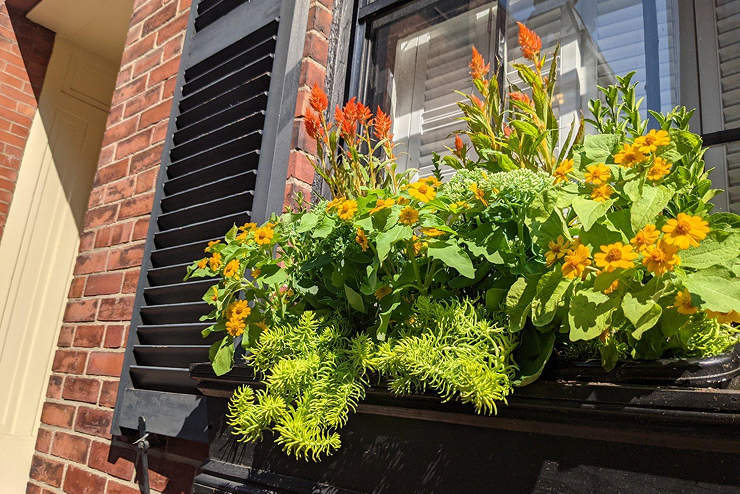
What we account for here
Four conditions come up on nearly every Wellesley property we plant, and each changes how we build the season.
Deer pressure from the college corridor and conservation land
Properties near Wellesley College, the reservation, or any wooded buffer see regular deer traffic, especially at dawn and dusk. We build plant lists around genuinely deer-resistant material — heavy on textured foliage, aromatic herbs, and plants deer reliably pass over — rather than relying on repellent sprays as the only line of defense. Where a client wants a plant deer typically browse, we place it closer to the house or combine it with a spray program we manage on a schedule, so it is not left to chance.
Deep shade under mature canopy
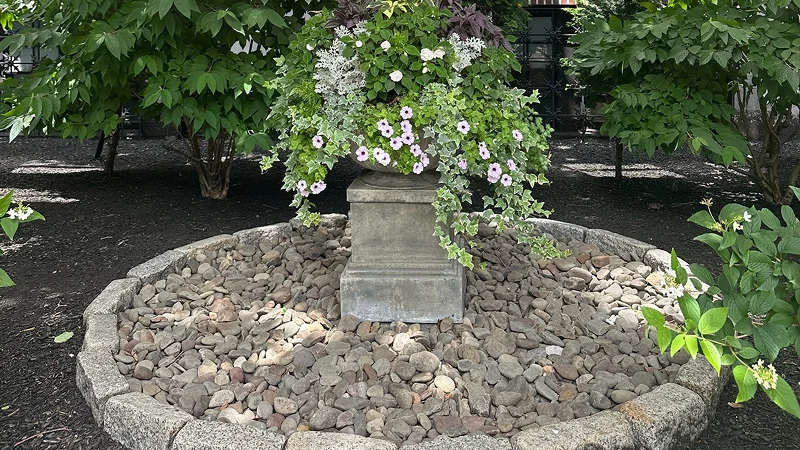
Century-old oaks and beeches mean many Wellesley entries and courtyards get filtered or dense shade from May through September. We lean on shade-tolerant textural planting — ferns, heuchera, hosta where deer pressure allows, caladium in warmer pockets — and adjust container placement to catch whatever dappled light does reach the ground, rather than fighting the tree canopy with sun-loving annuals that stretch and fail by July.
Formal garden continuity
On estate properties with an existing formal garden — boxwood parterres, a rose garden, a clipped hedge structure — container plantings need a restrained, coordinated palette rather than an independent design statement. We take color and form cues from what’s already planted and treat the containers as a seasonal accent to that structure, refreshed on the same rotation as the rest of the grounds.
Historic and neighborhood review considerations
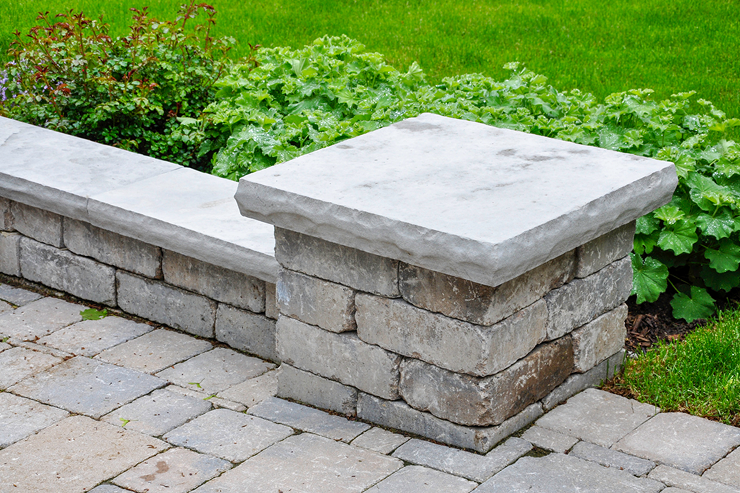
A number of Wellesley properties, particularly older estates and homes in designated historic areas, involve some form of commission or neighborhood association review for changes visible from the road. We design street-facing containers with that in mind from the outset — appropriate scale, material, and color for the setting — so nothing needs to be reworked after the fact.
Recent Wellesley work
Recent projects in Wellesley have included a full seasonal rotation of large-format urns flanking a stone entry drive on a property bordering conservation land, where the design had to hold up visually against deer pressure and a long sightline from the road. We’ve also planted a shaded rear courtyard on a Wellesley estate where the existing boxwood parterre set the color and form for a matching set of shade containers, refreshed each season alongside the formal beds. Both jobs shared the same starting point: read the existing landscape first, then build the container plan to sit inside it rather than beside it.
Other services we provide in Wellesley
Seasonal container planting is usually one piece of a broader relationship with Wellesley clients. We also provide full garden design and installation in Wellesley, working alongside estate landscapes and formal garden structures already on the property. Many of the same clients bring us in for ongoing fine gardening and maintenance to keep beds, hedges, and containers on a consistent schedule through the season. Where a home has a pool terrace, porch, or roof deck, we extend the same seasonal planting approach to those spaces, and we design and install drip irrigation so containers and beds stay properly watered without daily attention from the homeowner. For evening use of the grounds, we also install low-voltage landscape lighting along drives, entries, and garden paths, coordinated with the planting plan rather than added on afterward.
Start a Wellesley container planting plan
Wellesley is about 14.6 miles from our Wellesley location, and it’s a route we run regularly for estate and formal garden clients. Call Rouvalis Gardens to set up a consultation — we’ll walk the property, look at light, deer pressure, and any existing garden structure, and put together a seasonal plan built specifically for that site. After the call, expect a site visit scheduled within the week and a proposal that covers plant selection, container sourcing, and the seasonal rotation schedule for the year ahead.
What Our Customers Say
Frequently Asked Questions
Do you design container plantings around deer in Wellesley?
Yes. Deer pressure from the Wellesley College corridor, the reservation, and conservation land bordering many estate lots is one of the first things we plan around, using genuinely deer-resistant plant material rather than relying only on repellent sprays.
Can you match containers to an existing formal garden or boxwood parterre?
Yes. On estate properties with existing formal garden structure, we take color, form, and material cues from the existing beds and hedges so the container planting reads as an extension of the garden rather than a separate design.
How do you handle the deep shade under mature trees on older Wellesley properties?
We use shade-tolerant plant palettes for entries and courtyards under heavy canopy, and design a separate scheme for any sunnier terrace or pool area on the same property, since the two conditions need different plants.
Does street-facing container planting need historic or neighborhood association approval in Wellesley?
Some Wellesley properties, particularly in older or designated historic areas, involve neighborhood or commission review for changes visible from the street. We design with appropriate scale and material for that review from the start.
How often are Wellesley containers refreshed through the year?
Most estate clients run a spring, summer, and fall rotation timed to match their formal garden beds, with a winter evergreen or structural install for the colder months where the property calls for it.