- Serving Boston and the Greater Boston Area

Roof Deck Planting in Lexington, MA
A roof deck on a Lexington property usually sits above a house the historic district commission has an opinion about, in a town where deer move through side yards as freely as they move through the woods off Route 2A. Open, unshaded rooflines here mean full sun for most of the day, which is good for planting but hard on soil that dries out fast in containers. Any roof deck planting plan for Lexington has to work around all three conditions at once, not just the ones that are convenient.

What Roof Deck Planting looks like in Lexington
Lexington’s building stock skews older and more visible than most western suburbs — Colonial and Federal-era homes near the center, along Massachusetts Avenue, and around the Battle Green, many sitting inside or adjacent to the town’s historic districts. A roof deck addition or planting scheme on one of these properties is rarely a private matter. If the deck is visible from a public way, the historic commission’s review can extend to what grows on it, not just the structure underneath. We plan plant heights, container materials, and rail-mounted greenery with that sightline scrutiny in mind from the first conversation, not as an afterthought once a design is already drawn.
Beyond the review process, the physical conditions on a Lexington roof deck are demanding in their own right. These sites get long, uninterrupted sun exposure — there’s no adjacent tower or dense urban canopy cutting the light the way there is closer to Boston proper. That sun dries containers quickly, especially through July and August, so soil volume, container material, and irrigation all get sized up rather than treated as afterthoughts. And because Lexington is still substantially wooded and semi-rural in character even close to the town center, deer pressure follows plantings right up to the third floor in a way that surprises homeowners who assume rooftop height solves the deer problem. It does not, reliably, when there’s a connecting stair, ramp, or ground-level terrace deer can browse en route.
We build the planting plan around all three factors together: species and container choices that satisfy the commission’s expectations for scale and material, a watering strategy that holds up under full sun, and plant selections that don’t read as a deer buffet the first time a doe wanders up from the conservation land nearby.
What we account for here
What we account for here
Every Lexington roof deck brings its own combination of structural limits, wind exposure, and drainage patterns. We assess load capacity, containment systems, and irrigation access before choosing plants, so the design holds up long-term rather than looking good only on installation day.
- Weight and load distribution
- Drainage and waterproofing protection
- Wind exposure across the deck plane
Historic district approval and visible rooflines
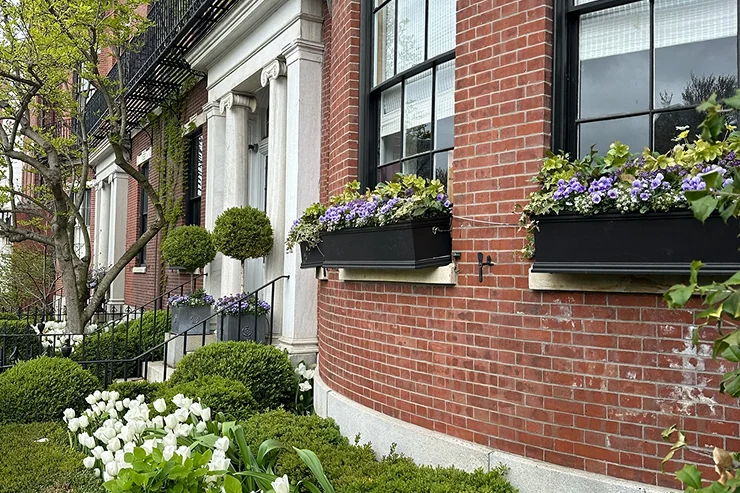
Where a roof deck is visible from the street or a public way inside one of Lexington’s historic districts, plant material and container style can factor into the commission’s review alongside the deck structure itself. We favor plantings and container finishes that read as restrained and period-appropriate from below — low profiles, muted materials, nothing that competes with the roofline — and we document plant selections clearly enough that if a homeowner needs to walk the commission through the planting plan, the case is already made.
Full, unbroken sun exposure
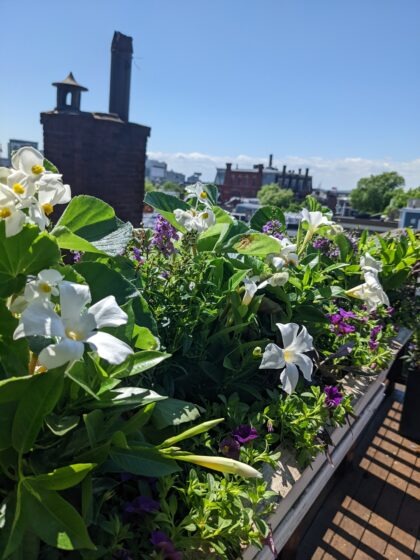
Lexington roof decks tend to sit above lower, more open building stock than downtown Boston, which means fewer neighboring structures casting shade and longer daily sun exposure on the deck surface. We size containers up, choose soil mixes that retain moisture without staying waterlogged, and specify drip irrigation on a timer for anything beyond a handful of pots, because hand-watering a full-sun roof deck through a Lexington summer is not a realistic maintenance plan for a busy household.
Deer pressure reaching rooftop plantings
Deer in Lexington aren’t confined to the outer edges of town — they move through yards near the center regularly, and they will climb an accessible stair or ramp to reach a terrace or lower roof deck that connects to grade. We select deer-resistant plant palettes for any roof deck with ground-level access nearby and reserve the most browse-attractive species for decks that are genuinely isolated from a path deer can use.
Wind and exposure on an open roof plane
An open roof deck with no adjacent structure to break the wind sees more consistent gusting than a sheltered terrace, which stresses tall or top-heavy plantings and dries soil faster than exposure alone would suggest. We anchor larger containers, choose plant forms that flex rather than snap, and build irrigation schedules around actual evapotranspiration on-site rather than a generic watering calendar.
Recent Lexington work
Recent work in Lexington has included planting for a roof deck addition on a historic-district property near the town center, where the design had to satisfy the commission’s expectations for scale and material before a single plant went in, alongside a full-sun terrace planting plan built around deer-resistant perennials and drip irrigation for a property with easy ground access on Follen Hill. Both projects shared the same starting point: understand the review requirements and the site conditions before proposing a single species.
Other services we provide in Lexington
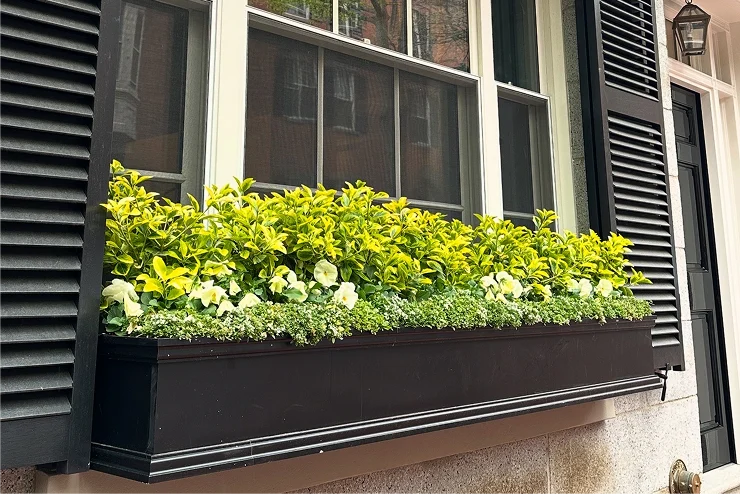
Roof deck planting is one piece of a broader Lexington practice. We handle full garden services in Lexington for properties that need more than a single deck addressed, including fine gardening and seasonal maintenance calibrated to the deer pressure common throughout town, container and window box plantings for period facades where historic review applies to street-facing elements, drip irrigation systems designed for the same full-sun exposure that affects roof decks, and low-voltage landscape lighting that respects both the historic district’s expectations and a homeowner’s evening use of the property. Many Lexington clients start with one service and add others once the first project is underway.
Start with a site visit
The next step is a site visit, not a proposal written blind. We walk the deck, note the sun path, check for deer access points, and if the property is inside a historic district, talk through what the commission will expect before we design around it. Rouvalis Gardens is based in Lexington, about 10.2 miles from Lexington center, and we schedule Lexington roof deck consultations directly — call to set a time and we’ll tell you plainly what the site allows and what it doesn’t.
What Our Customers Say
Frequently Asked Questions
Does the Lexington Historic Districts Commission review roof deck plantings, or just the deck structure?
It depends on visibility. If the deck and its plantings are visible from a public way within one of Lexington's historic districts, the commission's review can extend to plant scale, container materials, and screening, not just the deck's structural elements. We factor this in from the design stage for any historic-district property.
Will deer actually reach plants on a roof deck in Lexington?
If the deck connects to grade through a stair, ramp, or lower terrace, yes — deer in Lexington move through yards near the town center regularly and will browse anything they can reach. Decks that are genuinely isolated from ground access have far less exposure, and we plan plant selection differently for each case.
How much sun does a typical Lexington roof deck get compared to a Boston terrace?
More, generally. Lexington's building stock is lower and more open than downtown Boston, so there's less neighboring structure to cast shade. That means longer daily sun exposure, faster-drying containers, and a stronger case for drip irrigation over hand watering.
Can you match plantings to a Colonial or Federal-era home's period character?
Yes. We choose plant forms, colors, and container finishes that read as appropriate to the architecture and satisfy historic commission expectations where they apply, without making the deck feel like a museum piece rather than a place to actually sit.
How do I start a roof deck planting project in Lexington?
Call Rouvalis Gardens to schedule a site visit. We're in Lexington, about 10.2 miles from Lexington, and we come to the property to assess sun exposure, deer access, and any historic review requirements before proposing a plan.