- Serving Boston and the Greater Boston Area

Container Gardening in Newton, MA
A container planted for a sunny Back Bay stoop will not survive a season on a shaded Newton foundation bed, and it certainly will not survive the deer. Most of Newton’s village neighborhoods — Newtonville, West Newton, Waban, Chestnut Hill’s Newton side — sit on older lots where mature trees have closed the canopy over the front walk, foundation shrubs from the 1960s or earlier crowd the house, and deer move through yards on a nightly circuit. Add a town tree ordinance that governs what can and cannot come down to open up light, and container choices in Newton have to be made around constraints that a Boston rowhouse never faces.

What Container Gardening looks like in Newton
Container work in Newton starts with a walk of the lot, not a catalog order. Village lots here were built for foundation planting, not for pots, so the first question is always where a container can actually sit and get enough light to justify the investment. On many properties that answer is the front steps and the driveway apron — the two spots that clear the tree canopy for at least part of the day — while the shaded north and east foundation beds get a different planting strategy entirely, built around textures and evergreen structure rather than seasonal bloom.
Soil in Newton’s older village sections tends to be compacted clay that has been top-dressed for decades rather than amended, so containers are usually filled with a proper growing medium rather than relying on the ground bed underneath. That also solves half the deer problem — a raised, well-composed container of tender annuals draws less browsing pressure than the same plants set directly into a bed at nose height for a deer.
Because so many of these lots fall under some form of local design review, especially on streets with historic overlay near Newton Centre and Newton Corner, we design containers that read as part of the architecture rather than a retail display — matched materials, restrained color, and placement that respects sightlines from the street. And because the town’s tree ordinance limits what homeowners can remove or prune without a permit, container plantings are frequently the fastest legal way to add light-loving color to a lot where the canopy itself cannot be touched.
What we account for here
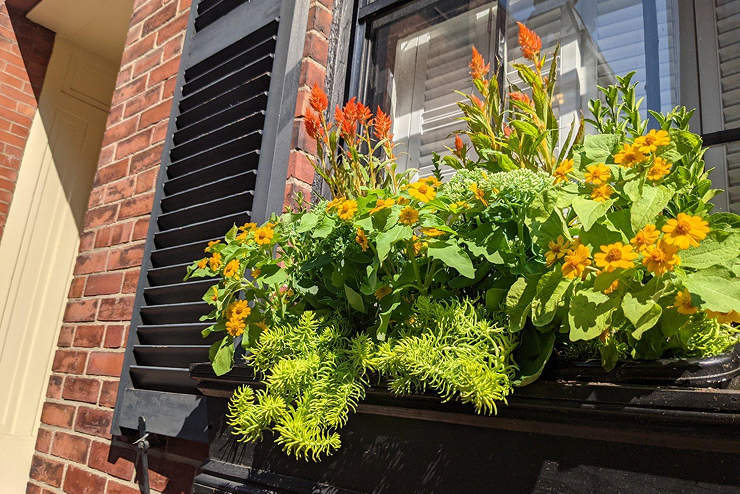
What we account for here
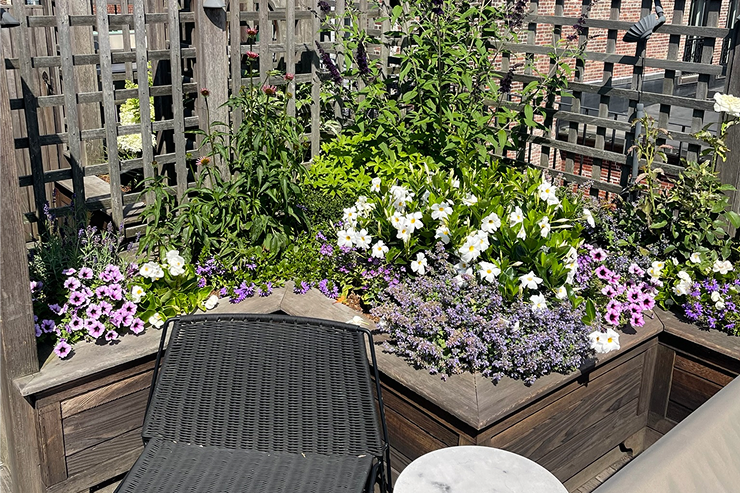
Newton properties bring their own set of conditions: exposure that shifts from a sunny driveway to a shaded side entry, soil that varies lot to lot, and seasonal swings that stress roots confined to a pot. We choose materials, drainage setups, and plant combinations suited to each spot, then adjust watering and feeding through the season so containers stay full and healthy.
- Right-sized pots and soil mixes for the location
- Drainage built in from the start
- Seasonal swaps as conditions change
Recent Newton work
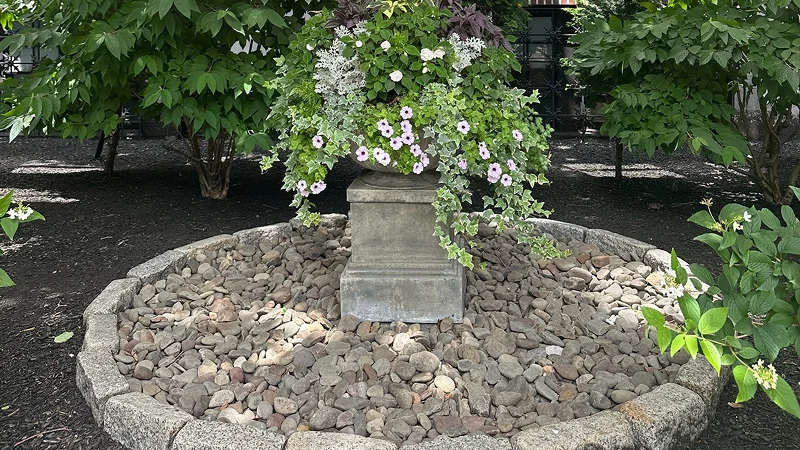
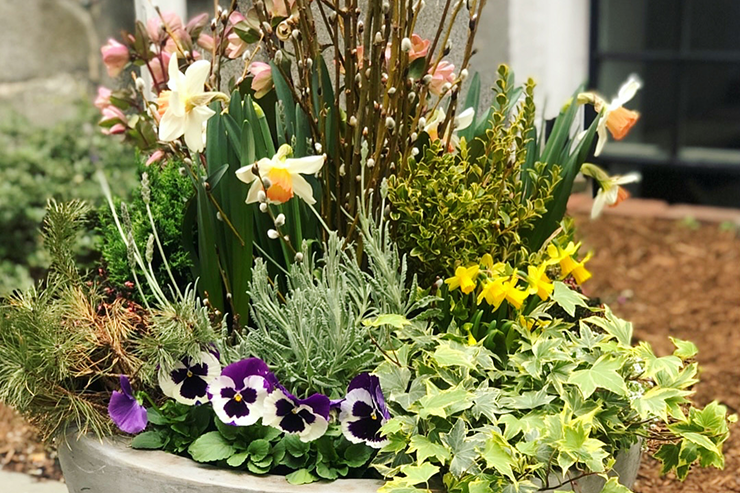
A recent project on a Chestnut Hill-adjacent lot in Newton involved replacing overgrown foundation yews — left in place under the tree ordinance rather than removed — with a run of large cedar containers planted for deep shade and finished with a low-voltage accent light on each. On a Newton Centre property closer to the sidewalk, we built a pair of matched entry containers sized and detailed to satisfy an informal streetscape review before a single plant went in. Neither project required a permit for the containers themselves, which is often the deciding factor for homeowners who have already spent time navigating tree removal approvals for other parts of the property.
Other services we provide in Newton
Container gardening is rarely the only work a Newton property needs, and we handle the rest of the lot as one coordinated plan rather than a series of separate call-outs. That includes full garden design and installation for lots where the foundation plantings themselves need rethinking, ongoing fine gardening and maintenance visits scheduled around the growing season, window boxes for street-facing facades under design review, roof deck and terrace planting for the newer condo conversions near Newton Centre and Newtonville, drip irrigation runs to keep containers and beds alive through August without daily attention, and low-voltage landscape lighting to carry a planting scheme into the evening. We also handle seasonal changeovers, deer-resistant bed planting for the open lots most exposed to browsing, soil renovation for compacted clay sections, and consultation on which foundation shrubs can be thinned within the limits of the town’s tree ordinance.
Village lots and the tree ordinance
Newton’s tree preservation rules mean a homeowner cannot simply cut back an overgrown foundation planting to bring in more light for containers. We work within that reality by designing container placement around the existing canopy rather than fighting it, and by choosing planting palettes for the shaded zones that do not depend on removing anything. Where a permit-eligible thinning is possible and worthwhile, we say so plainly and let the homeowner decide before we plant a thing.
Deer pressure across the lot
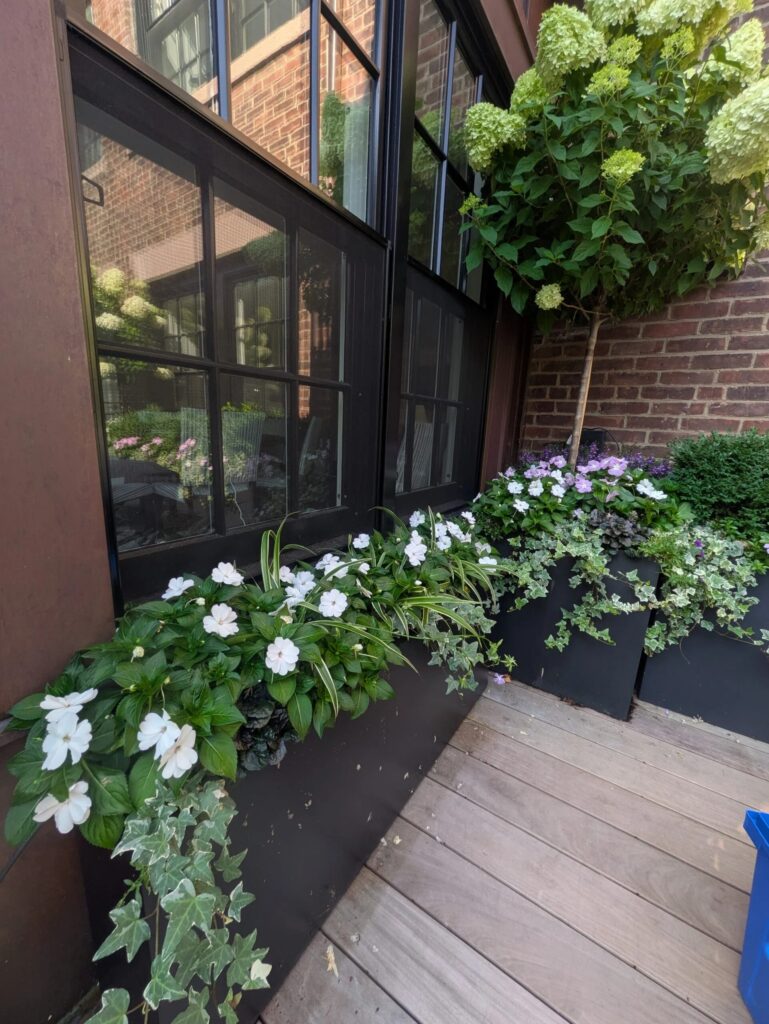
Deer move through nearly every Newton village neighborhood on a predictable route, and container plantings positioned near that route get tested within the first week. We plant the most deer-favored annuals — tulips, hostas in bloom, soft new growth — in elevated containers close to the house rather than at ground level in open beds, and we use scent and taste deterrents in rotation during the highest-pressure spring weeks so containers are not stripped overnight.
Foundation shade and established trees
Many Newton lots have fifty- and sixty-year-old maples and oaks that block direct sun across the entire front of the house for most of the day. Rather than fighting that shade with plants that will only limp along, we build container schemes around foliage contrast, evergreen structure, and a small number of shade-tolerant bloomers, reserving true sun annuals for the driveway apron or a rear deck that actually clears the canopy.
Rouvalis Gardens serves Newton from Newton
Rouvalis Gardens is based at 5 Crescent St, Newton, MA, roughly 8.6 miles from Newton’s village centers. That distance is not an obstacle — our crews route through the western suburbs regularly for scheduled maintenance and design work, and a Newton container project is handled with the same design process, the same materials, and the same crew continuity as our Newton and Boston work.
What Our Customers Say
Frequently Asked Questions
Will deer eat my container plants in Newton even if the containers are raised off the ground?
Raised containers reduce browsing significantly but do not eliminate it, particularly in yards on regular deer routes near Newton's wooded lots. We combine placement close to the house, rotating deterrents, and plant selection that favors texture over the soft new growth deer prefer.
Does Newton's tree ordinance affect what I can plant in containers?
The ordinance governs removal of established trees, not container plantings, so it does not directly restrict what goes into a pot. Where it matters is light: if a foundation tree cannot be thinned without a permit, we design the container palette around the shade that tree casts rather than assuming more sun than the lot actually gets.
My front steps face the street in a Newton Centre historic overlay area. Does that limit container choices?
It can affect scale, material, and color more than plant selection. We design street-facing containers to read as understated and architecturally appropriate, which typically clears informal neighborhood review without issue.
Can you work around foundation shrubs I'm not allowed to remove?
Yes. Most of our Newton projects start from the assumption that existing foundation plantings stay in place, and we design container placement and plant choices to work alongside them rather than requiring removal first.
How often do container plantings in Newton need attention?
Shaded foundation containers typically need less frequent attention than sun containers on a driveway apron, but both benefit from a scheduled maintenance visit through the growing season plus a seasonal changeover in spring and fall.