- Serving Boston and the Greater Boston Area

Landscape Lighting in Weston, MA
A two-acre lot in Weston is rarely lit the way a half-acre lot in the next town over is lit. The trees are older and taller, the driveways run longer than most streets in the city, and deer move through the understory every evening on paths that have nothing to do with where your patio or front walk happens to sit. Any lighting plan here has to account for canopy shade that shifts by the hour, cable runs that can exceed anything a standard low-voltage transformer handles cleanly, and fixtures that need to survive contact with animals that treat your beds as a corridor. We design for those conditions specifically, not around them.

What Landscape Lighting looks like in Weston
Weston’s lots are large enough that lighting is less about accenting a single facade and more about laying out a sequence — the approach off the road, a stretch of stone wall, a run of specimen trees, then the house itself. That sequencing matters more here than in tighter suburbs because there’s simply more ground to cover, and more darkness between the points of interest if it’s handled poorly.
The wooded canopy that gives these properties their privacy also filters daylight unevenly, which means the same fixture and fixture angle that reads correctly under an open lawn will look flat or washed out under heavy oak and maple cover. We do most of our layout work at dusk on site, adjusting for the actual light conditions of each specific bed rather than a lighting plan drawn from a daytime site visit.
Long driveways and set-back homes also change the electrical math. A run from the transformer to a fixture at the far end of a Weston property can be three or four times the distance you’d see on a Weston or Brookline lot, which means voltage drop has to be calculated correctly or the last fixtures in the line will glow dimly no matter how good the bulb is. We size transformers and gauge cable runs for the actual distances involved rather than defaulting to a standard residential spec that assumes a modest suburban yard.
Deer pressure is heavy across most of Weston, and it shows up in lighting work in a specific way: fixtures and cable staked at ground level in beds that deer travel through regularly get knocked loose, stepped on, or nosed out of position within a season if they’re not set correctly. We anchor fixtures below grade where the planting allows it and route cable along hardscape edges and under mulch beds deer are less likely to disturb, rather than running exposed wire across open lawn panels.
What we account for here

What we account for here
Deer traffic through planted beds
Fixtures set at surface level in a bed that deer cross nightly rarely stay put. We recess low-voltage fixtures and secure cable connections below the mulch line, and where a bed sits directly on a known deer path, we favor uplighting from adjacent hardscape over ground-level well lights that are easier to disturb.
Deep, shifting canopy shade
A fixture angle that works under open sky reads completely differently under mature tree cover, and the shade pattern itself changes through the season as leaves fill in and drop. We test placement at dusk rather than relying purely on daytime measurements, and we plan for the property’s fullest summer canopy so the lighting still performs correctly once the trees have leafed out.
Long cable runs from the house
Weston’s larger lots mean the distance from transformer to the farthest fixture is often well beyond what a standard suburban lighting plan assumes. We calculate voltage drop across the full run and size cable gauge and transformer output accordingly, so fixtures at the end of a long line aren’t left dimmer than the ones near the house.
Historic district and neighborhood review
Portions of Weston fall under design review for exterior changes visible from the street, and lighting can fall into that category depending on placement and fixture type. Where a property is subject to review, we plan fixture visibility and glare with that in mind from the start, rather than adjusting after the fact.
Recent Weston work
Recent work in Weston has included path and specimen-tree lighting along a long wooded driveway where the existing fixtures had dimmed noticeably toward the property line, a full re-route of buried cable damaged by root growth under an established rhododendron bed, and uplighting for a stone wall and terrace where deer traffic had repeatedly displaced the original well lights. In each case the starting point was the same: walk the property at dusk, map where deer actually move, and design the run distances and fixture placement around what the lot is doing rather than a standard template.
Other services we provide in Weston
Landscape lighting is one part of a broader scope of work we handle on Weston properties. Many of our lighting clients also come to us for general garden services in Weston, including garden design and installation suited to large, partly wooded lots, fine gardening and ongoing seasonal maintenance, container and window box plantings for entries and terraces, roof deck and terrace planting where the property includes one, and drip irrigation systems built for the long runs and uneven soil conditions common on estate-size parcels. We coordinate lighting alongside these services so cable routing, planting plans, and irrigation lines are designed together rather than layered on top of each other after the fact.
Landscape Lighting, Weston, MA — 13.8 miles from our Weston base
We travel to Weston regularly and treat the distance as a standard part of the route, not a special trip. Whether you’re planning lighting for a new planting install, adding it to an existing garden, or replacing an underperforming older system, the next step is a site visit at dusk so we can see the actual conditions — shade, deer paths, and run distances — before proposing a layout. Call to schedule that visit, and we’ll follow up with a plan specific to your property, not a standard package.
A typical Weston lighting plan
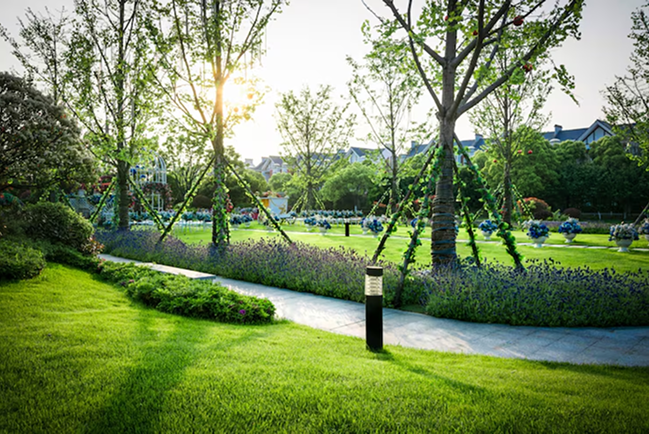
Many Weston properties call for lighting a long driveway approach with low, evenly spaced fixtures, then layering in uplights on mature trees or stone walls that define the front acreage. On backyards with pools, patios, or terraced gardens, we add step lights and downlighting from tree canopies to keep transitions safe after dark. Wiring and transformers are run underground and placed discreetly near existing utility access, keeping the finished look clean and unobtrusive.
Questions Weston homeowners ask before installing lighting
Before committing to a landscape lighting plan, most Weston homeowners want to know how the system holds up on wooded, multi-acre lots and whether it fits with existing plantings and stonework. We walk through fixture placement, wiring routes around mature trees and long driveways, and how the design adapts as gardens mature.
- Will fixtures disturb established root systems or garden beds?
- How does the lighting perform across a large, tree-covered lot?
- Can the plan expand later as landscaping changes?

Ready to see your Weston property after dark?
Schedule a walk-through of your driveway, gardens, and entry points before dusk. We’ll map fixture locations, discuss transformer placement, and give you a straightforward quote based on what your property actually needs.
- Evening site visit
- Fixture and wiring plan
- Written quote, no surprises
What Our Customers Say
Frequently Asked Questions
Does heavy deer pressure in Weston affect how landscape lighting is installed?
Yes. Where deer travel regularly through planted beds, we recess fixtures below grade and route cable under mulch or along hardscape edges rather than leaving fixtures and wire exposed at surface level, since exposed installations get disturbed within a season on high-traffic properties.
Can landscape lighting work with the shade from mature trees on my property?
It can, but the plan has to be built around it. We do fixture placement at dusk under actual canopy conditions rather than relying only on daytime site visits, since the same angle that reads well in open sun often looks flat under heavy tree cover.
My driveway and main planting beds are far from the house — does that limit what's possible?
It changes the electrical planning, not the design. Long cable runs need larger-gauge wire and correctly sized transformers to avoid voltage drop at the far end of the line, and we calculate that for the actual distance involved rather than using a standard suburban spec.
Does my property need approval before adding exterior lighting?
Some Weston properties fall under design review for exterior changes visible from the street. If your property is subject to that kind of review, we account for fixture visibility and glare during the design stage so the plan holds up under scrutiny.
How does landscape lighting in Weston compare to lighting work you do in Wellesley or Lexington?
The core approach — dusk-based layout, correct voltage drop calculation, and deer-aware fixture placement — carries across all three towns, since they share similar lot sizes and wildlife pressure. See our <a href="/landscape-lighting-wellesley-ma/">Wellesley</a> and <a href="/landscape-lighting-lexington-ma/">Lexington</a> lighting pages for how conditions differ by property.