- Serving Boston and the Greater Boston Area

Window Boxes in Newton, MA
A window box on a Newton Center or Waban house has to compete with what’s already growing at the foundation, survive deer that move through the village lots at dusk, and often work in shade thrown by a tree the town won’t let you cut back. That’s a different design problem than an open, sunny lot. The answer is a plant list and irrigation setup chosen for exactly those pressures, not a generic mix of trailing annuals.

What Window Boxes looks like in Newton
Newton’s older neighborhoods — Newton Centre, Auburndale, Waban, Chestnut Hill’s Newton side — were built with substantial foundation plantings: yews, boxwood, mature rhododendron hugging the base of the house. A window box installed above that layer needs to read as an addition to an established scheme, not a competing one. We look at what’s already rooted below the sill before we choose color or texture, so the box complements rather than clashes with forty-year-old plantings the homeowner has no interest in removing.
Shade is the second constant. Many Newton lots carry heavy tree canopy — old sugar maples, oaks, mature ornamentals that predate the current owners — and a north- or east-facing box under that canopy gets a fraction of the light a south-facing box on a treeless lot would get. We plan for it: heuchera, ferns, dead nettle, and shade-tolerant trailing plants instead of the sun-hungry standards that would thin out and stop blooming by July.
Deer are the third factor, and in Newton they are not occasional. Village lots back onto conservation land, golf courses, and each other’s yards in a way that gives deer a continuous route through the neighborhood. A window box at ground-floor height is an easy target. We build boxes around deer-resistant plant selections first and treat that as a design constraint from the start, not an afterthought sprayed on after something gets eaten.
The town’s tree ordinance also comes up more than people expect. If a window box installation requires trimming a branch that’s shading the window, or if a homeowner wants to remove a shrub to make room for a new box, Newton’s regulations on tree work — particularly on public shade trees and larger specimens — can require a permit or review. We flag that early so it doesn’t stall a project mid-install.
What we account for here
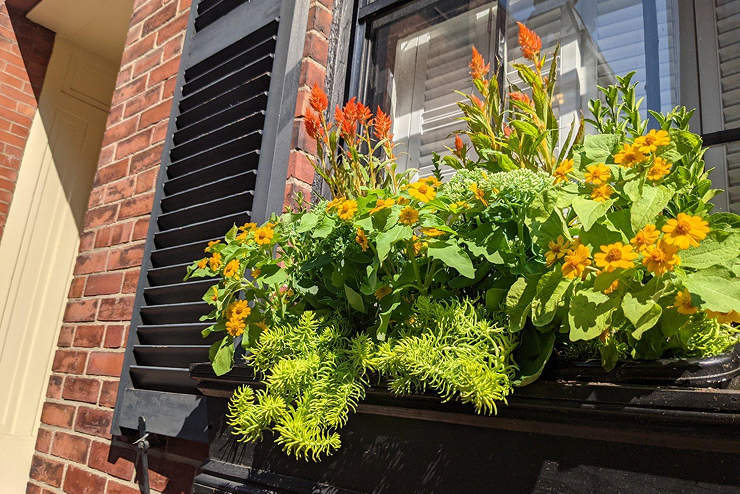
What we account for here
Newton’s older homes bring a mix of window styles, sill depths, and siding materials, so we start by checking that a box can be mounted securely without straining the frame or trapping moisture against the wall. Sun exposure varies block to block, and we factor in whether a window faces a shaded side street or an open, south-facing front.
We also plan for New England’s seasonal swings, choosing brackets and drainage that hold up through freeze-thaw cycles and heavy spring rain.
- Mounting compatibility with existing trim
- Drainage and weight limits
- Sun and wind exposure by elevation
Established foundation plantings
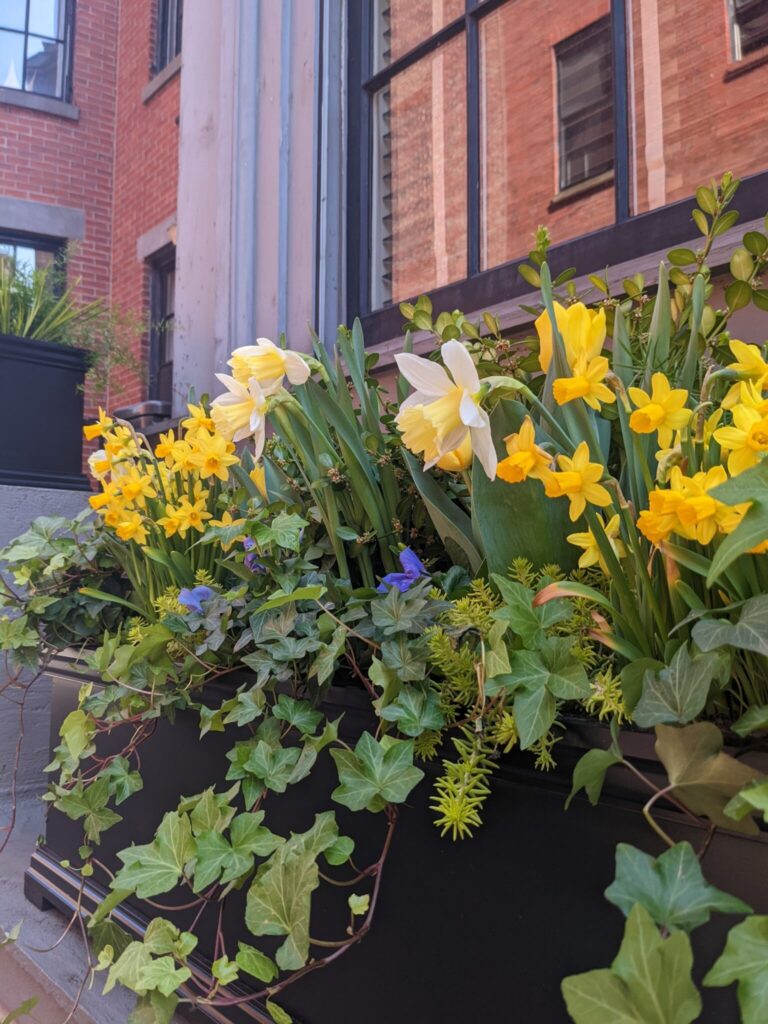
Boxes are sized and planted to sit above and alongside existing yews, boxwood, and hydrangea rather than visually competing with them. We match the palette to what’s already established so the house reads as one composition, not two separate garden decisions layered on top of each other.
Deer pressure
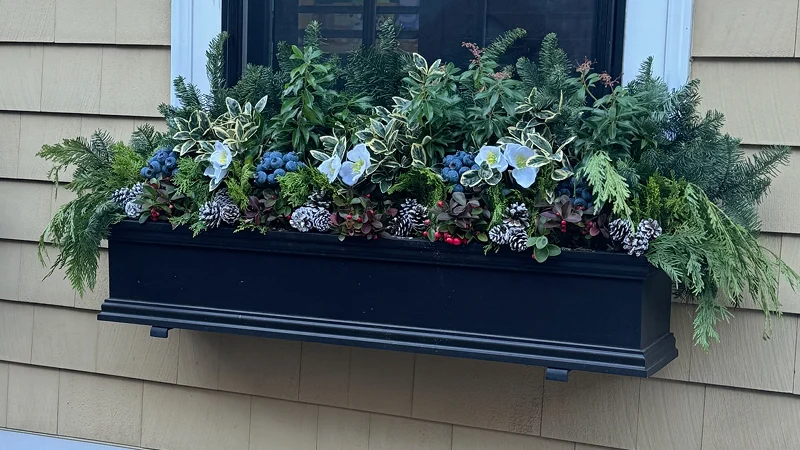
Village lots near conservation land and golf courses see regular deer traffic. Our default plant list for Newton leans on deer-resistant selections — lamium, licorice plant, certain heucheras, dusty miller — with fragrant or textured foliage deer tend to pass over, rather than relying on repellent sprays that need constant reapplication.
Heavy shade from mature canopy
Older Newton lots often carry oaks and maples that block direct sun for most of the day. We select shade-adapted plants and adjust watering schedules accordingly, since shaded boxes dry out differently than sun-exposed ones and overwatering in low light is a common failure point we design around.
Tree ordinance and removals
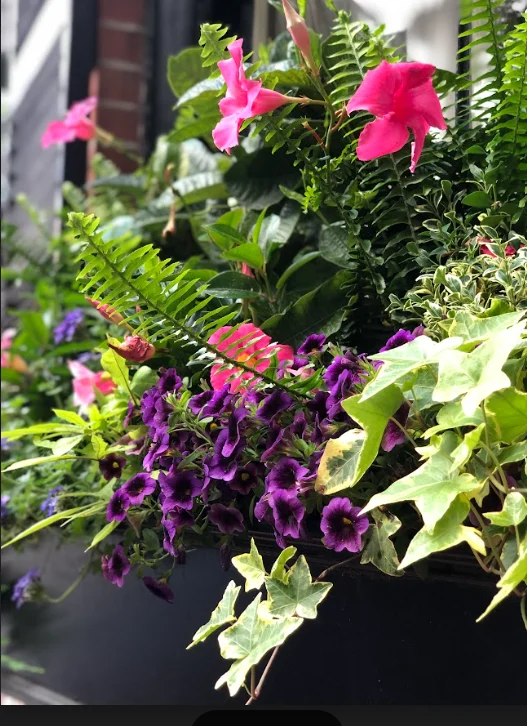
Where a box installation intersects with a branch, sightline, or shrub the town considers a protected or public shade tree, we check what Newton’s tree ordinance requires before any cutting happens. That keeps a straightforward window box project from turning into a permitting delay discovered too late.
Recent Newton work
Recent work in the Newton village centers has included window boxes on Colonial and Victorian-era homes where the brief was consistent: keep the box in scale with mature foundation plantings, choose selections deer will leave alone, and account for shade cast by street trees the town won’t allow altered. On several projects the box design was built around a specific tree canopy pattern that shifts through the season, with plantings chosen to hold color as available light changes from spring to fall.
Other services we provide in Newton
Window boxes are usually one piece of a broader Newton project. We also handle garden design and installation in Newton for homeowners reworking beds around those same foundation plantings, ongoing fine gardening and maintenance to keep both the boxes and the surrounding beds looking intentional through the season, container plantings for porches and entries, roof deck and terrace planting for the town’s condominium and multi-unit properties, drip irrigation lines run to boxes and beds alike so watering isn’t left to memory, and low-voltage landscape lighting that shows off foundation plantings and window boxes after dark without floodlighting the whole facade.
Start with a consultation
Newton is roughly 8.6 miles from our Newton location, and we plan window box work here around the same site visit we’d use for any garden project — walking the property, noting sun exposure, deer activity, and any tree or shrub near the install site before proposing a plant list. Call to set up a consultation and we’ll tell you plainly what will and won’t hold up on your specific lot.
What Our Customers Say
Frequently Asked Questions
Will deer eat window box plantings in Newton?
They can, particularly in neighborhoods near conservation land or golf courses where deer move through regularly. We build Newton window boxes around deer-resistant selections like lamium, dusty miller, and certain heucheras rather than relying on repellents alone, which cuts down on the damage significantly though not to zero.
Do I need a permit to trim a tree for a window box installation in Newton?
It depends on the tree. Newton's tree ordinance covers public shade trees and certain larger specimens, so if a window box install requires cutting back a branch that falls under that protection, a permit or town review may be required. We check this before starting work so it doesn't come up mid-install.
Can window boxes work in the shade under mature trees?
Yes, with the right plant selections. Ferns, heucheras, dead nettle, and other shade-tolerant trailing plants hold up well under heavy canopy, though they need a different watering approach than sun-loving annuals since shaded soil dries out more slowly.
How do you keep a new window box from clashing with existing foundation plantings?
We look at what's already established — yews, boxwood, hydrangea, whatever's rooted at the base of the house — before choosing the box's color and plant texture, so the new planting reads as an extension of the existing scheme rather than a separate decision stacked on top of it.
Do you install and maintain the window boxes, or just design them?
Both. We install the boxes and the planting, and most Newton clients add ongoing seasonal maintenance so the boxes get refreshed as plantings fade and replanted for the next season without the homeowner having to manage it.