- Serving Boston and the Greater Boston Area

Seasonal Container Planting in South End, MA
If you own a bowfront on a South End block, your containers are doing double duty: they are the only planting most passersby ever see, and they sit under the review of the South End Landmark District. Add a shared community garden culture where neighbors compare window boxes over the fence, and long narrow alley gardens that get sun for three hours a day if they’re lucky, and it becomes clear why off-the-shelf planters rarely hold up here. Seasonal container planting in the South End has to satisfy the street, the season, and the district guidelines at once.

What Seasonal Container Planting looks like in South End
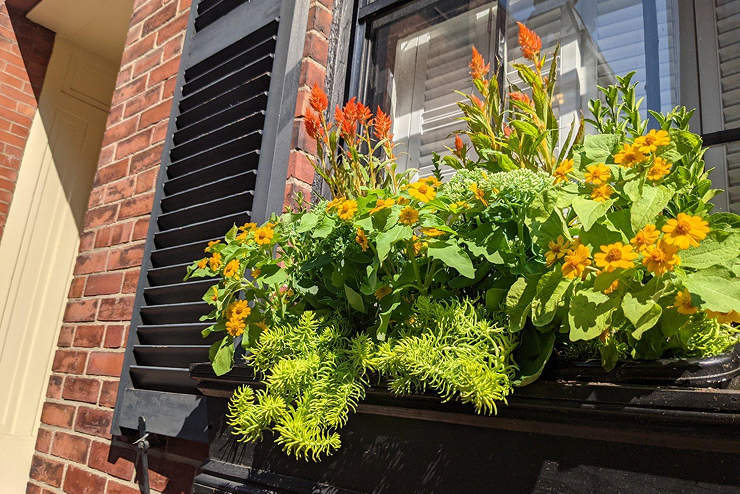
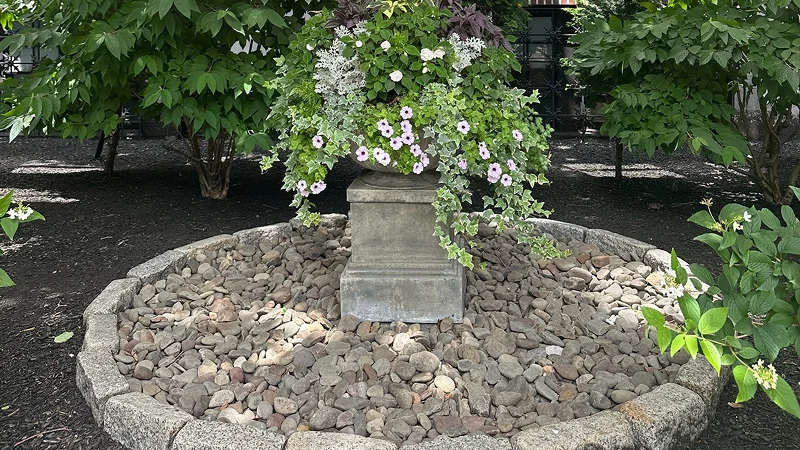
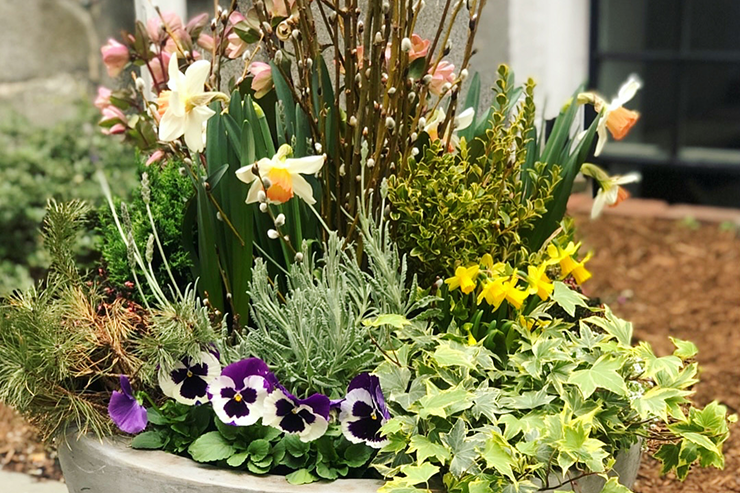
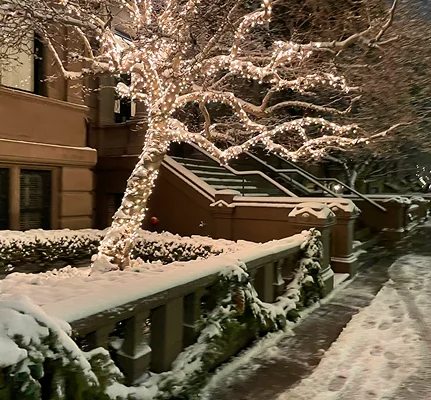
On a typical South End project, we start with the bowfront itself. These curved brick facades create a stage — the containers flanking the stoop or set into the ironwork are the first thing anyone registers about the house, and they read differently against red brick in January than they do in June. We plan four rotations a year around that backdrop: spring bulbs and cool-tolerant foliage, a summer scheme built for heat bouncing off brick and pavement, a fall changeover heavy on texture once the summer color fades, and a winter arrangement of cut greens, birch, and berry that has to survive wind funneling down the block without looking picked-over by February.
Soil is rarely native soil here — most South End containers sit on stoops, ironwork, or brick paving with no bed beneath them, so drainage and weight both matter, especially on older ironwork that was never engineered for saturated soil. Light is inconsistent street to street: a Union Park bowfront can get strong afternoon sun while a Rutland Square unit two blocks over sits in near-constant shade from taller neighbors. We read each address rather than applying a single South End template. And because so many blocks fall inside the Landmark District, we design containers and any visible hardware to stay within what the commission expects for that block, so nothing you place out front becomes a compliance problem later.
What we account for here
What we account for here
Landmark District review on street-facing containers
Containers, urns, and any fixed planters visible from the public way in the South End Landmark District fall under commission guidelines on material, color, and placement. We keep container selection and mounting hardware within the range the district has already approved on similar blocks, so you are not the test case for a new material.
Long, narrow alley gardens with limited light
South End alley and rear gardens are often barely wider than a doorway and boxed in by three-story brick on both sides. We choose species that hold form and color in filtered or partial light rather than fighting for full-sun performance the space can’t deliver, and we plant in tiers so the narrow sightline still reads as full.
Shared community garden culture and sightlines
Many South End blocks maintain active community gardens and a strong tradition of coordinated window box and stoop planting. We take the block’s existing palette into account — matching or intentionally complementing what neighboring properties are doing — rather than planting something that looks out of step with the street.
Bowfront ironwork and weight limits
Historic ironwork brackets and window box rails were not built for today’s soil volumes when fully saturated. We size and fill containers to stay within safe working loads for the specific ironwork on your building, and we use lightweight soil mixes on any mounted or bracketed planter.
Recent South End work
A recurring project type in the South End is the paired stoop-and-window-box program on a bowfront row house: matching containers at street level and window boxes above, planted on the same seasonal schedule so the whole facade changes together rather than in mismatched pieces. We’ve also handled long alley gardens behind Union Park and Rutland Square-area homes, where the brief is usually the same — make a shaded, narrow space feel deliberate rather than leftover, and keep it presentable with minimal watering visits given how little rain reaches those corridors under overhanging brick.
Other services we provide in South End
Container planting is often the entry point, but most South End clients eventually fold it into a broader garden services plan for South End. That can include drip irrigation run discreetly to stoop and window box containers so watering isn’t a daily obligation during summer heat, low-voltage lighting along entry stairs and alley gardens sized to Landmark District expectations, and fine gardening visits that keep both the street-facing containers and the rear courtyard on the same maintenance calendar. For roof decks and rear terraces above the garden level, we handle wind-tolerant planting suited to that exposure, and for a full design pass on a bowfront’s front, rear, and roof spaces together, we scope it as one project rather than three separate ones.
What a South End container plan actually costs you in time
Most owners we work with in the South End are not looking to manage plant selection, soil mix, or seasonal timing themselves — they want the facade to look right in every season without four separate decisions a year. A container plan sets the rotation dates, the palette per season, and the maintenance visits up front, so the only thing that changes on your end is what you see out the window.
Start a South End container planting plan
Rouvalis Gardens is based at 5 Crescent St in South End, about 3.1 miles from the South End, and we schedule container work throughout the neighborhood on a regular seasonal calendar. Call to set up a walk-through of your stoop, window boxes, or alley garden — we’ll assess light, access, and any Landmark District considerations on site, then propose a planting and rotation schedule before any work begins. Most South End clients hear back with a plan within a few business days of that first visit.
Bring container color to your South End address
From bowfront stoops to rooftop decks, South End’s tight, high-visibility spaces call for a planting plan built around your exact footprint and light. Reach out and we’ll arrange a walkthrough, discuss access and any building or trustee requirements, and put together a seasonal rotation suited to the space.
What Our Customers Say
Frequently Asked Questions
Do South End container plantings need Landmark District approval?
Any container or planter visible from the public way on a South End Landmark District block is subject to commission guidelines on material and placement. We select containers and mounting that fall within what the district has already approved for similar bowfront blocks, so you avoid a separate review process for routine seasonal planting.
Can you work with the ironwork and brackets already on my bowfront?
Yes. We assess the existing brackets and rail hardware for safe working load and size the containers and soil mix to stay within that limit, rather than defaulting to standard container weights that may be too heavy for older ironwork.
My rear alley garden gets almost no direct sun — is container planting worth it there?
Narrow South End alley gardens boxed in by three-story brick rarely get more than a few hours of filtered light. We plant for that condition specifically, using species chosen for partial or filtered light performance rather than full-sun varieties that will thin out and fail.
How many times a year do you rotate containers?
Most South End properties run four rotations: a spring planting, a summer scheme, a fall changeover, and a winter arrangement of greens and natural materials. Some clients scale back to three if the front containers are more sheltered and hold their look longer.
Do you coordinate with what neighboring properties are planting?
Where it's useful, yes. South End blocks often have an informal shared planting culture, and we take the existing palette on a block into account so a new container program complements rather than clashes with what's already established nearby.