- Serving Boston and the Greater Boston Area

Container Gardening in South End, MA
A South End bowfront gives you a stoop and a pair of narrow window ledges to work with, not a yard — and whatever you put there faces the street, the South End Landmark District Commission, and the block’s shared sense of what belongs on a bowfront. Add a rear alley garden squeezed between brick party walls and you have two entirely different growing problems on one property. Container gardening here has to answer to both at once.

What Container Gardening looks like in South End
Most South End properties fall into one of two categories: the street-facing bowfront with its bracketed window boxes and stoop urns, or the long, narrow alley garden behind it that neighbors can often see into, and sometimes tend collectively. Both call for container work, but the brief for each is different.
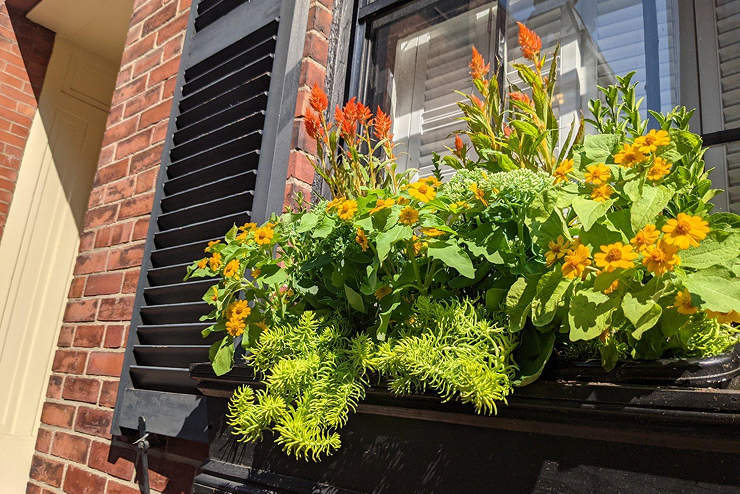
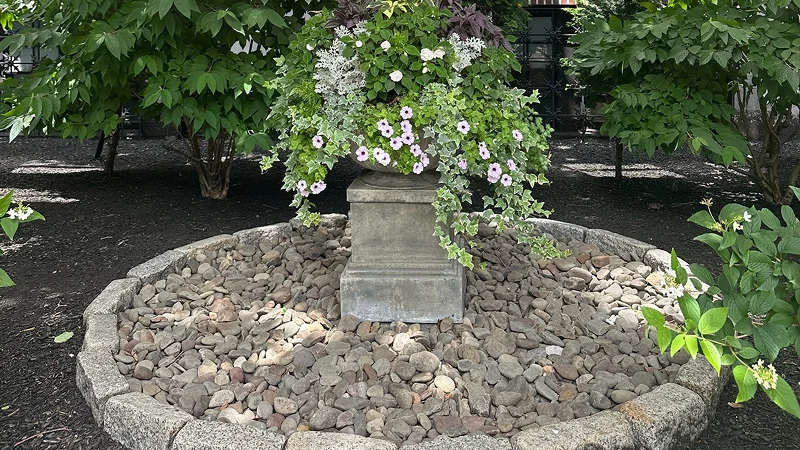
On the street side, the container itself is part of the architecture. Window boxes sit on brackets fixed to a facade that may be 130 years old, urns flank a stoop that’s shared visual territory with six other stoops on the block, and anything installed has to read as considered rather than decorative-for-its-own-sake. Materials matter — fiberglass and lead-look composite read correctly against brick and brownstone in a way that glossy glazed ceramic often doesn’t.
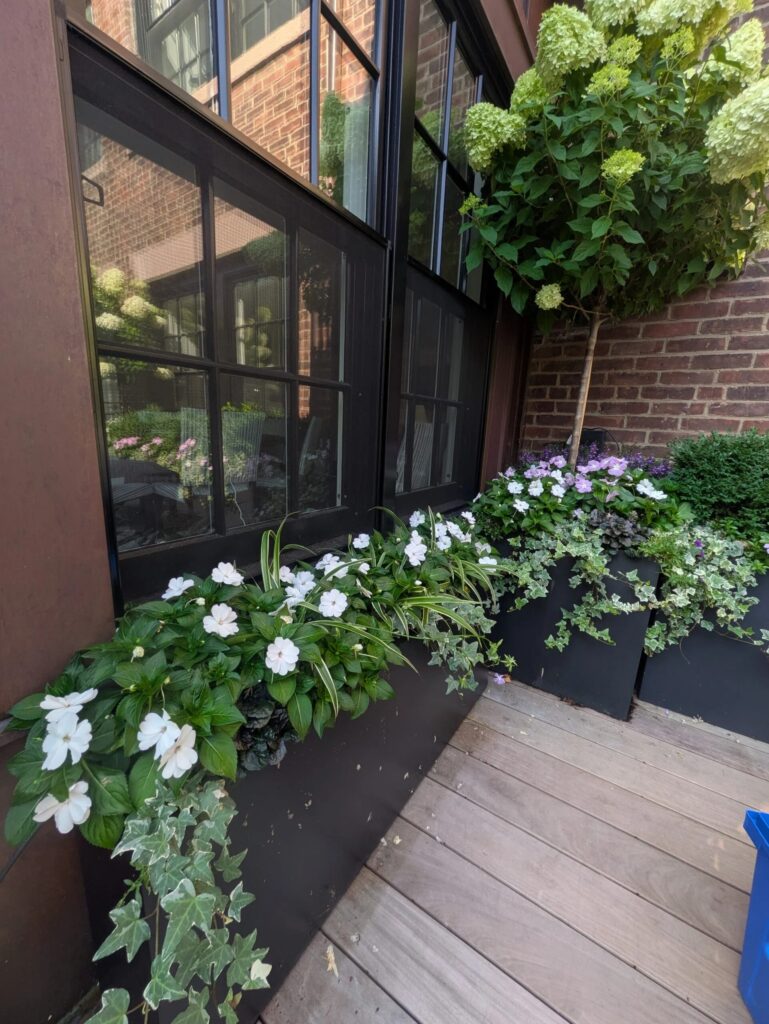
Behind the building, alley gardens run long and thin, walled in brick on both sides, often shared or overlooked by two or three abutting properties. Light arrives in a narrow band for a few hours a day, wind funnels rather than blows, and soil — where there’s soil at all rather than pavers — tends to be compacted, alkaline from decades of brick and mortar runoff, and short on drainage. Containers solve for all of that: raised planting depth, controlled soil, and placement that chases the light band as it moves through the season.
We plant for both conditions on the same visit where a property has them, using drip irrigation on a timer for anything more than a few containers deep, since hand-watering a stoop and an alley on the same schedule is where most self-managed container gardens fail by August.
What we account for here
What we account for here
Four conditions come up on nearly every South End container project. Here’s how we handle each.
Landmark District review on anything street-facing
Window boxes, brackets, and stoop urns visible from the public way fall under the South End Landmark District’s purview, and the commission has clear expectations around scale, material, and color that vary somewhat by sub-district. We design within those parameters from the start — the right bracket profile, a planting palette that reads as appropriate to the facade rather than trend-driven — so the work doesn’t need to be revisited after installation.
Shared alley gardens and community garden culture
Many South End alley gardens are informally or formally shared among abutters, with an established culture of who plants what and where. We work within that arrangement rather than around it, coordinating placement and plant choice so a private container garden complements the shared space instead of crowding it.
Long, narrow growing footprints
Alley gardens here are typically deep and narrow rather than wide, which limits both the size of containers you can move through the space and the equipment we can bring to install and maintain them. We size and stage everything for hand-carry access — no gear that needs a gate wider than the one you have.
Bowfront-specific light and wind
A bowfront’s curved facade creates its own microclimate — window boxes at different points along the curve can get materially different sun exposure, and the projecting bay can funnel wind along the sidewalk. We map exposure box by box rather than treating a facade as one uniform planting.
Recent South End work
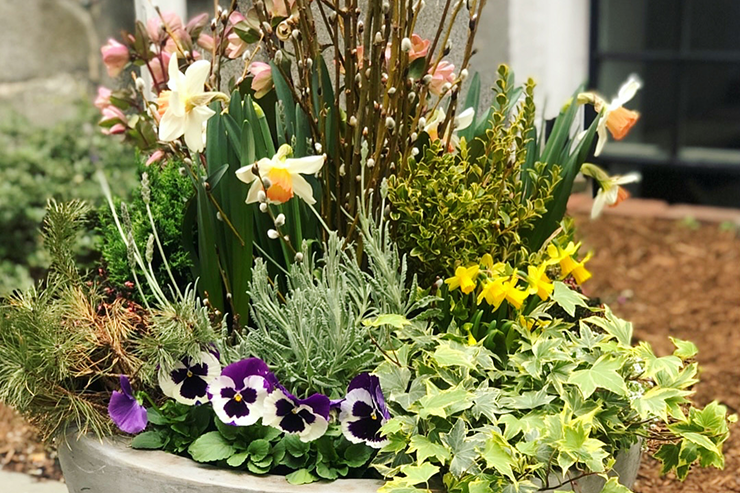
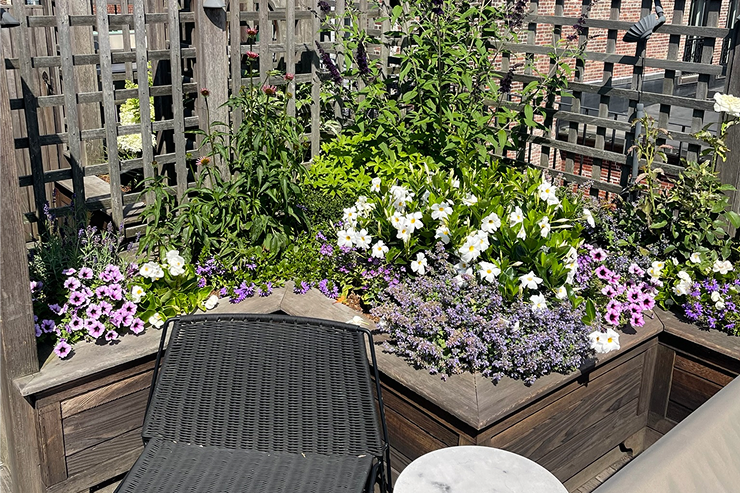
A recurring project type on these blocks: a full bowfront refresh — stoop urns and every window box on the facade replanted on a seasonal rotation — paired with a rear alley garden brought up from bare brick and pavers to a working container garden with drip irrigation run off an exterior spigot. The two halves of the property get planted to different briefs but installed and maintained on the same schedule, which is generally what makes ongoing care manageable for the owner.
Other services we provide in South End
Container gardening is rarely the only need on a South End property. We also provide full garden services in South End, including garden design and installation for alley and courtyard spaces, fine gardening and ongoing maintenance to keep street-facing plantings looking correct through the season, roof deck and terrace planting for the South End’s flat-roof decks and setback terraces, drip irrigation designed for narrow, walled-in growing spaces, and low-voltage landscape lighting that highlights a bowfront’s brick and ironwork without running afoul of Landmark District lighting guidelines. A conversation about one need often turns up two or three others worth addressing on the same visit.
Container gardening beyond South End
We provide the same service citywide — see our container gardening in Boston overview, or view our work in Brookline and Cambridge, two other neighborhoods with their own mix of historic review and tight urban footprints.
Getting started
Rouvalis Gardens is based at 5 Crescent St, South End, MA, about 3.1 miles from South End — close enough that a first visit, a follow-up planting, and a mid-season check can all happen on a realistic schedule rather than a once-a-year drive-by.
Call to set up a consultation. We’ll walk the bowfront and the alley if you have both, note what’s under Landmark review and what isn’t, and follow up with a plan and a planting schedule before anything gets ordered.
Other services we provide in South End
Container gardening is often just the starting point for what South End properties need. Many of our container clients also rely on our garden design and installation service to plan out stoop gardens, small side yards, or rear patios that connect naturally with their pots and planters. Once everything is in place, our fine gardening and maintenance visits keep containers and surrounding beds groomed and healthy through the changing seasons.
For row house stoops and street-level facades, our window box design and installation work pairs well with container arrangements to unify the whole frontage. If your outdoor space is a roof deck or small terrace, our roof deck and terrace planting service handles the wind exposure and weight limits particular to those settings. Consistent watering matters for any container setup, which is why we also install drip irrigation systems sized for South End’s tight courtyards and planters.
- Spring and fall cleanup
- Seasonal container rotation and refresh
- Soil and drainage assessment
- Low-voltage landscape lighting for evening use
- Planting design consultation for phased projects
See our full garden services page for the complete list of what we offer South End clients.
Ready for container gardens on your South End stoop or terrace
Request a consultation and we’ll schedule a visit to your stoop, courtyard, or rooftop. We’ll evaluate sunlight, wind exposure, and space constraints, then follow up with a tailored container design, plant selection, and a clear quote before any planting begins.
What Our Customers Say
Frequently Asked Questions
Do window boxes on a South End bowfront need Landmark Commission approval?
Anything visible from the public way — window boxes, brackets, stoop urns — falls under South End Landmark District review, and requirements vary by sub-district. We design to the applicable guidelines from the outset so the installation doesn't raise issues later.
Can you plant an alley garden that's shared with neighboring properties?
Yes. Many South End rear gardens are informally shared among abutters. We coordinate placement and plant choice to fit that existing arrangement rather than disrupt it.
What grows well in a narrow, brick-walled South End alley garden?
Shade-tolerant and part-shade plants that can handle a compacted, alkaline soil profile do best — we typically use raised containers with amended soil rather than relying on the ground itself, since it's usually compacted and poorly drained.
Do you handle watering for stoop and alley containers, or just installation?
Both. Most South End properties get drip irrigation on a timer plus ongoing seasonal maintenance, since hand-watering a stoop and a rear alley on separate schedules is where most container gardens struggle by mid-summer.
How far is South End from your South End location?
About 3.1 miles. We schedule consultations, installs, and mid-season maintenance visits on a regular route through the neighborhood.